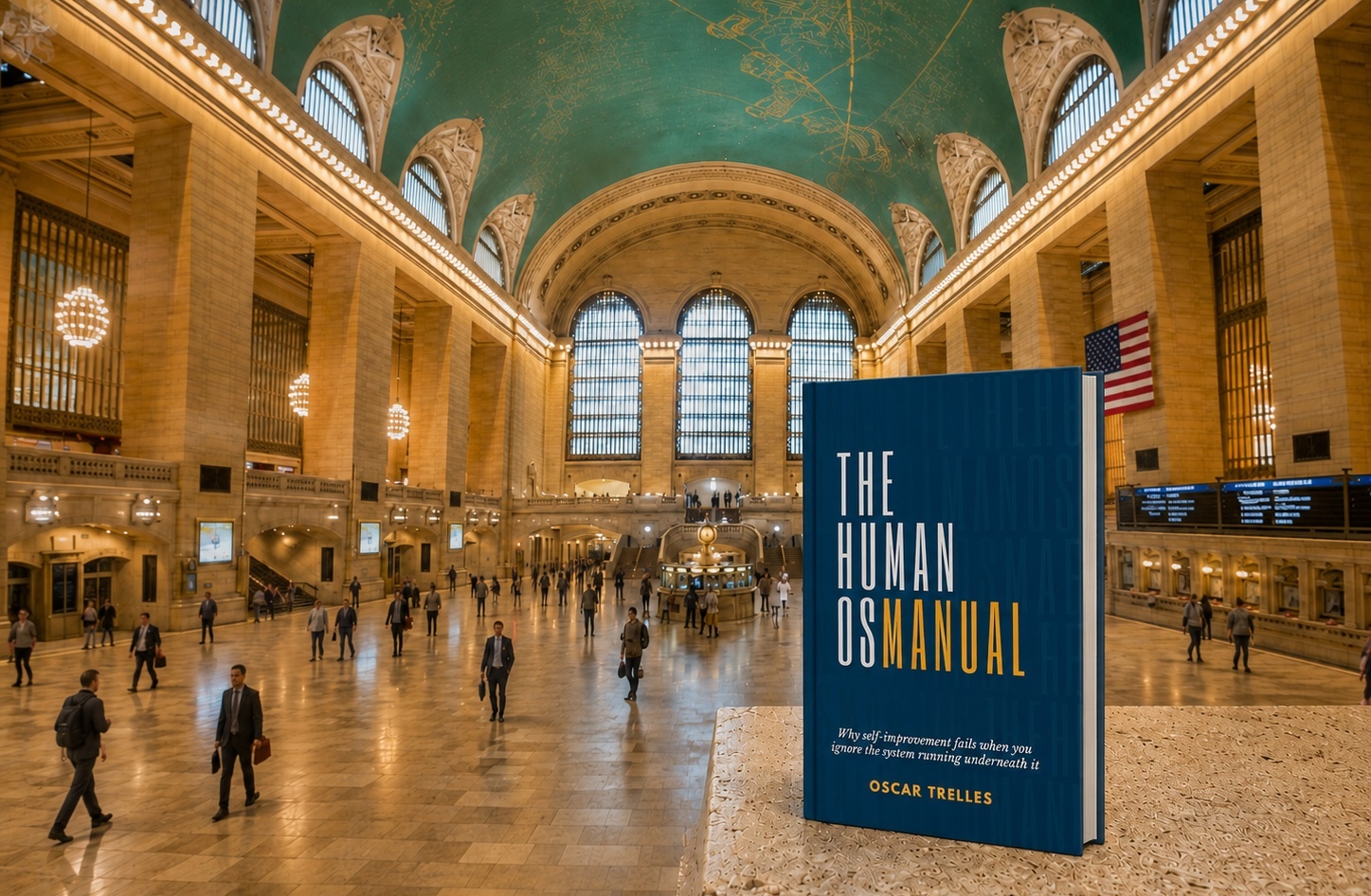
The Human OS Manual
Why Self-Improvement Fails When You Ignore the System Underneath
You are not broken. You are running a system you were never taught to understand.
Many people are still functioning, but everything takes more out of them than it used to. Most self-improvement starts too late. It asks you to fix habits, mindset, productivity, stress, sleep, health, and aging as if they were separate problems. But no one lives in pieces.
The problem
Many people already know what would help.
They know sleep matters. Movement matters. Food matters. Recovery matters. Boundaries matter. Stress matters. Relationships matter.
The problem is that knowing what helps is not the same as living inside conditions that allow change to hold.
When the system underneath remains overloaded, fragmented, or under-recovered, people can change for a while and still return to the same patterns under pressure. The behavior looks personal. The cause is often systemic.
No one lives in pieces
A poor night of sleep changes appetite, patience, decision-making, movement, and the next night's conditions.
Work pressure enters the body you bring home.
Incomplete recovery changes what kind of person you have enough capacity to be.
Relationships, environment, rhythm, stress, and aging all shape the same living system.
The Human OS Manual teaches you how to read that system.
What the Human OS reveals
The Human OS is the living operating system beneath your daily life.
It includes what enters the system, the state you operate from, whether recovery completes, how behavior emerges, which patterns repeat, and how the body adapts over time.
The point is not to turn life into a diagram. The point is to make visible what is already shaping experience.
When the system becomes legible, responsibility becomes more precise. Change becomes less dependent on force. The aim shifts from optimizing isolated parts to building a life your body can actually inhabit.
What the book helps readers understand
- Why life can remain functional while becoming harder to sustain
- Why knowing what helps is not the same as being able to make change hold
- Why sleep, energy, mood, focus, food, stress, work, relationships, and aging cannot be solved separately
- Why achievement can continue while recovery, range, and durability decline
- Why familiar patterns return under pressure, and how to build coherence that survives real life
When this book is useful
The Human OS Manual is useful when you are still functioning but everything takes more out of you than it used to; when you know what would help but cannot make the changes hold; or when sleep, energy, mood, focus, food, stress, work, and relationships feel connected even though they are treated separately.
It is also for the person whose achievement continues while durability declines, or whose changes work for a while and collapse under pressure.
These are not separate audiences. They are different situations in which the same underlying system becomes visible.
About Oscar Trelles

Oscar Trelles spent more than two decades studying how people behave inside systems built for attention, performance, trust, and change, across advertising, strategy, market research, technology, cybersecurity, entrepreneurship, and commercial leadership.
After severe burnout, he spent fifteen years rebuilding his health, resilience, and operating rhythm. The Human OS Manual grew from the continuity between those two periods: the same systems inquiry, brought closer to physiology, recovery, behavior, adaptation, environment, and healthspan.