Human OS / Research Atlas
Sunrise and Civil Time, 2026
Human OS / Research AtlasOscar Trelles23 October 2026Version 1.0
What kind of morning does morning-light advice assume?
Get outside soon after waking. Find sunlight before checking your phone. Build a morning routine around the first few minutes of the day. These instructions sound portable: wherever you live, morning follows waking.
The clock and the sky do not always agree. At 07:00, one person may already be well past sunrise while another is still waiting for it. The relationship changes with latitude, longitude, season, time-zone boundaries and daylight-saving rules. A routine anchored to waking also depends on when that person actually gets up.
This investigation asks a bounded question: how does the timing of conventional sunrise vary when expressed in the civil time people use to organize their days? It calculates sunrise throughout 2026, maps the latest clock-time sunrise and the number of dates with sunrise by 07:00, and supplements those maps with hypothetical ten-minute waking windows in 38 cities.
The purpose is to make the conditions behind a timing instruction visible. It is not a test of whether morning outdoor light is beneficial, a prescription for when to wake, or a measurement of the light reaching anyone’s eyes.
Two ways to read the same year
The first map asks how late sunrise gets during the year at each sampled location. The second asks how often sunrise occurs by the chosen cutoff. They answer different questions: an annual extreme describes the most demanding date for a fixed deadline; a frequency describes how often the deadline is met.
07:00 is an illustrative local clock time. It is not an estimate of the world’s typical waking time or a biological boundary. Someone who wakes at 05:30 or 08:30 encounters a different relationship between waking and sunrise. The maps establish the geographical comparison; the separate scenarios introduce stated waking times.
How late does sunrise get?
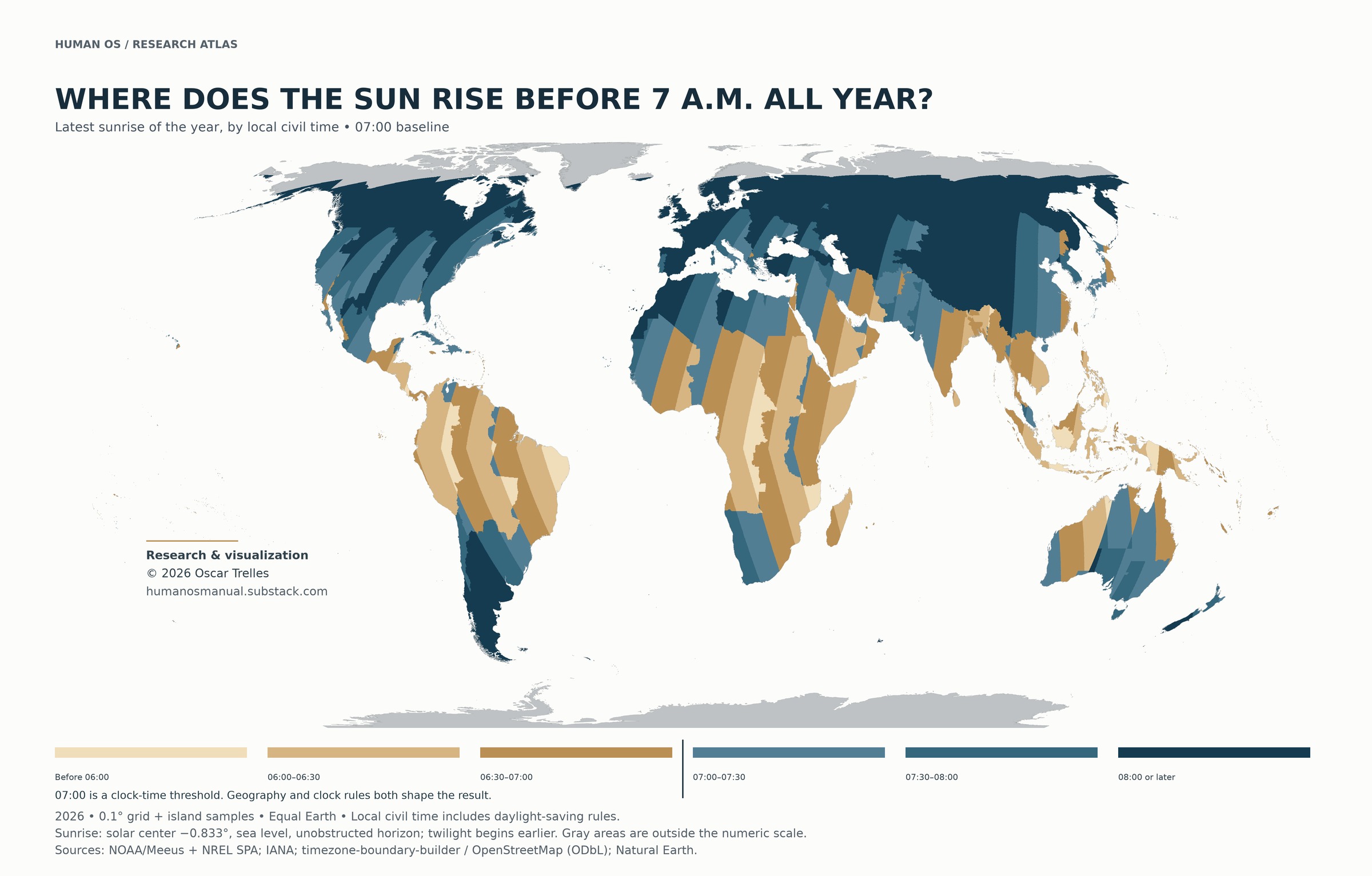
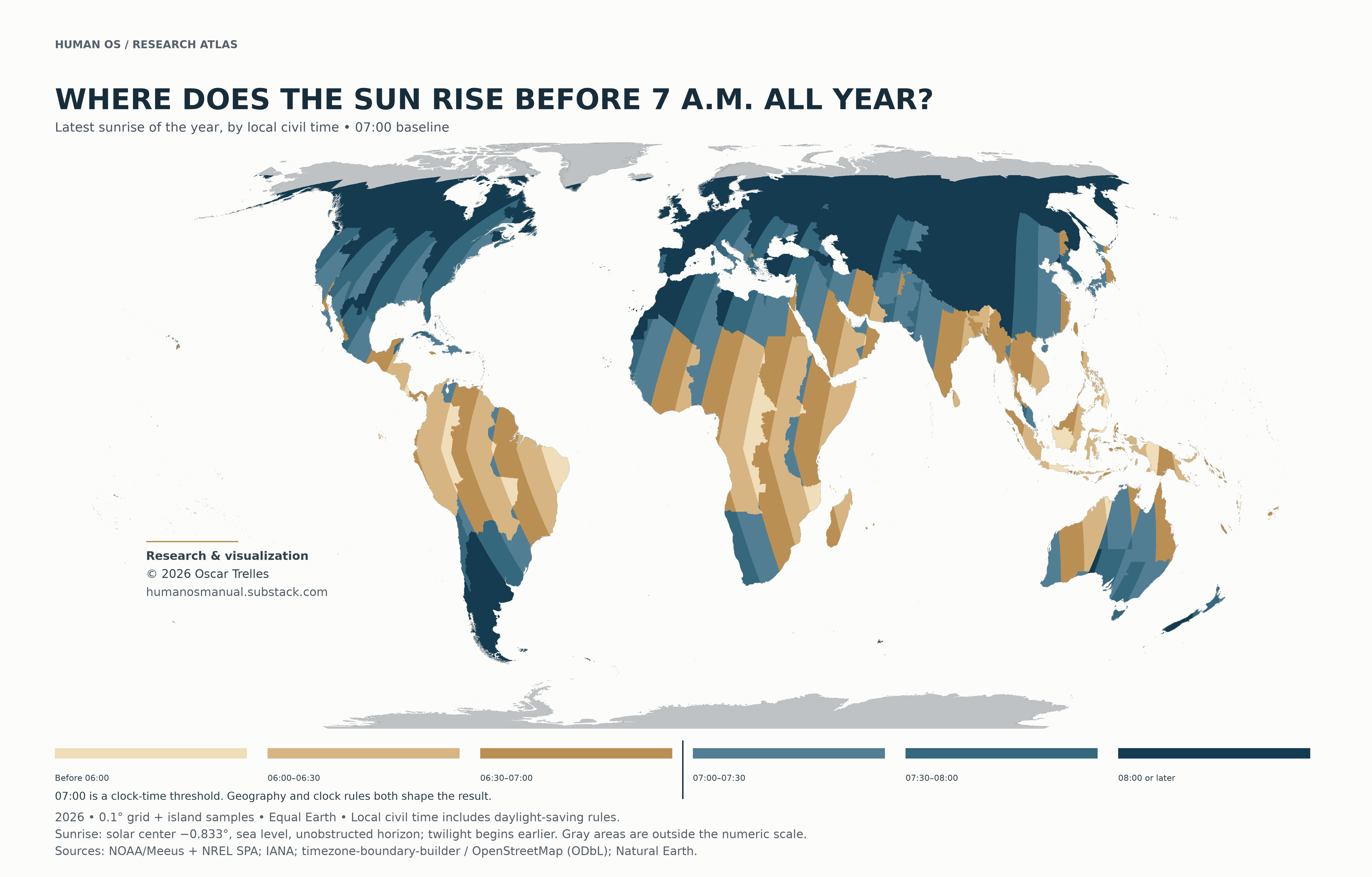
The first map shows the latest modeled sunrise clock time found across the local calendar year. Its title asks where sunrise stays strictly before 07:00 throughout the year. Among the locations included in the numeric scale, those with an annual maximum below 07:00 meet that condition. The map also shows how far later the maximum falls elsewhere. The underlying records retain the exact times and dates; the colors group them into intervals.
Lighter colors indicate earlier annual maxima and darker blues indicate later ones. An annual maximum is not a description of every morning. A location whose latest sunrise is after 07:00 may still have many dates with sunrise before it. The first map alone cannot tell us how many.
Latitude helps explain seasonal differences, but the map also shows the effect of civil time. Positions within a time zone share clock rules while occupying different longitudes. A political boundary or a daylight-saving change can shift the clock-time expression of sunrise without creating an equivalent jump in the Sun’s physical movement. Differences between neighboring annual maxima may also involve different dates, so they should not automatically be read as same-day clock jumps.
How often has sunrise occurred by 07:00?
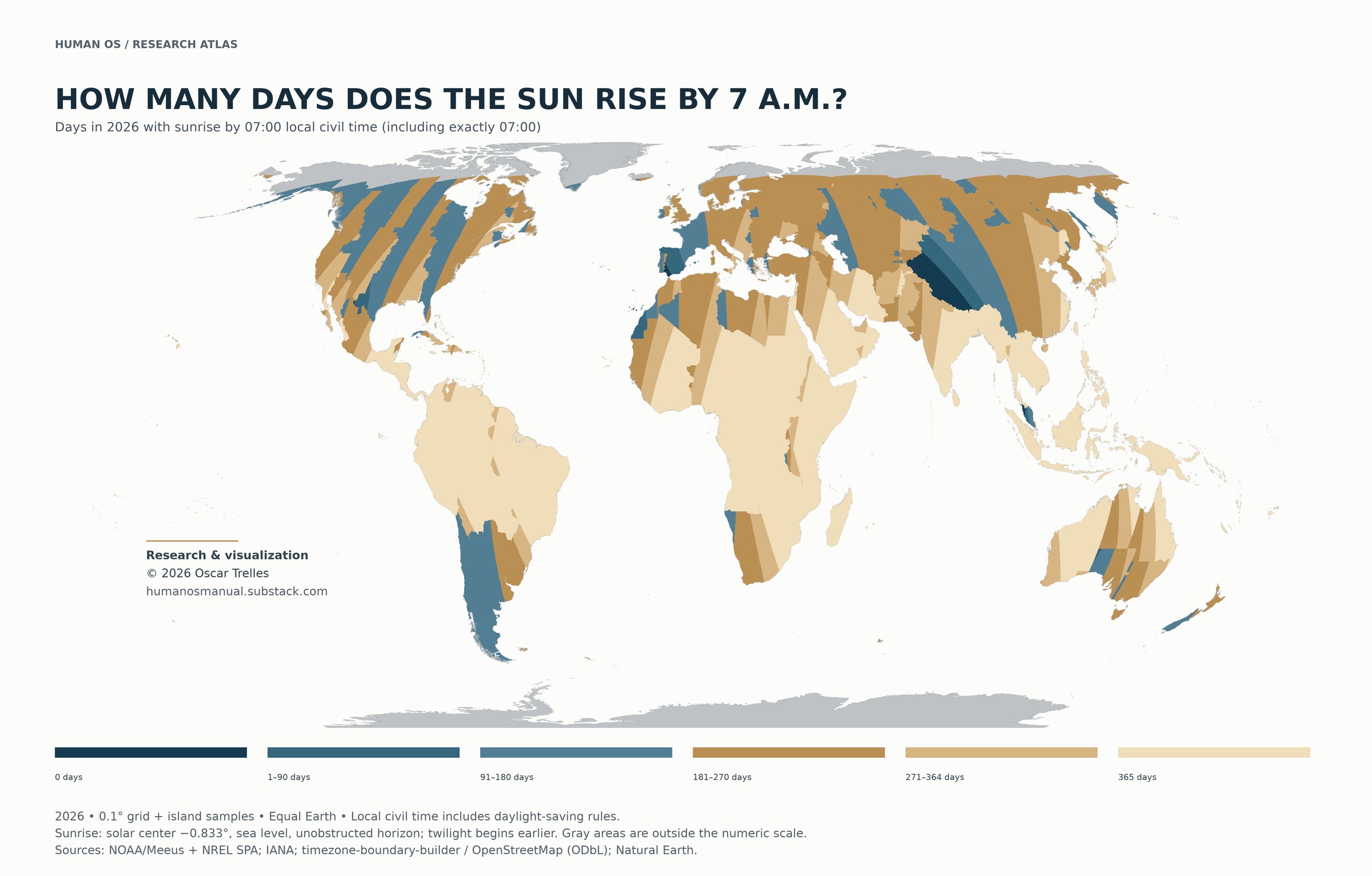
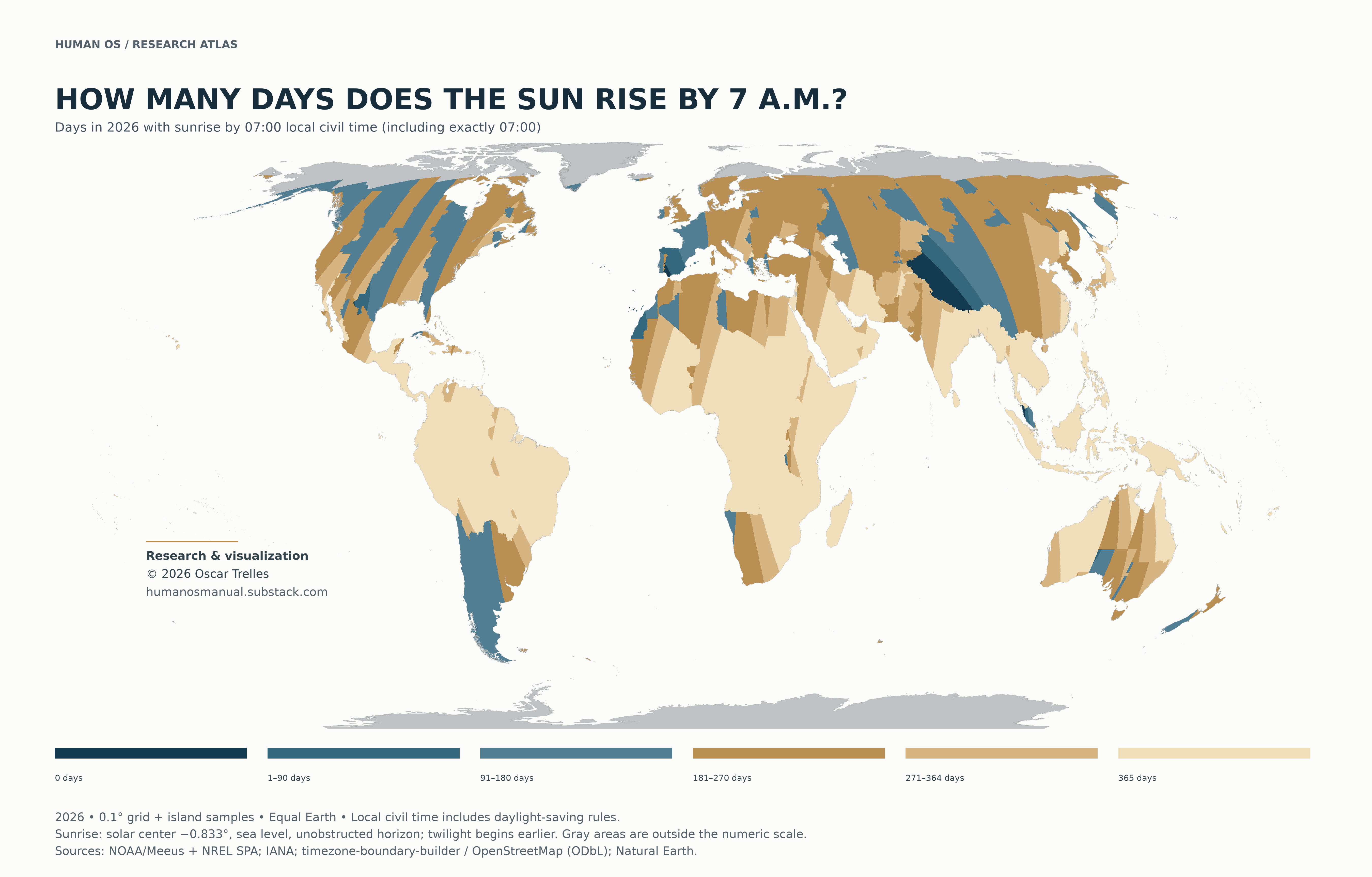
The frequency map counts dates with sunrise at or before 07:00, including exactly 07:00. A lighter color means more qualifying dates; a darker color means fewer. This direction keeps the question in the title aligned with the legend. Unlike the first map’s strict “before,” this measure includes equality.
The count is 365 minus dates without a sunrise event minus dates with sunrise after 07:00. Dates without sunrise do not qualify as sunrise-by-07:00 dates. That accounting must not be mistaken for a measure of darkness: in polar regions, no sunrise event can occur during continuous daylight as well as during polar night.
Both maps therefore show exceptional cases in gray, outside the numeric color scale. These include locations with at least one missing daily sunrise or sunset, Antarctica, land assigned nautical time zones and unresolved conflicting clock rules. Gray does not mean zero light, zero qualifying days or a biological disadvantage.
What the city comparisons make concrete
The city calculations use explicit reference coordinates rather than the nearest global grid cell. The following examples show why neither latitude nor a familiar clock label is enough to describe the morning. Times below are rounded to the nearest minute for reading; the source table retains seconds.
| Reference city | Latest sunrise (local) | Dates with sunrise by 07:00 / 365 |
|---|---|---|
| Málaga | 08:33 | 22 |
| Madrid | 08:38 | 66 |
| London | 08:06 | 231 |
| Los Angeles | 07:13 | 341 |
| Nairobi | 06:42 | 365 |
| Beijing | 07:36 | 269 |
| Kashgar | 10:17 | 0 |
| Singapore | 07:17 | 168 |
In the model, Málaga has sunrise by 07:00 on 22 dates, while Los Angeles has it on 341. Nairobi has it on all 365. These results leave counterexamples intact: the chosen deadline is readily met in some places and not in others. They do not support a claim that everyone faces the same constraint or that most people cannot follow a routine.
Beijing and Kashgar illustrate a different mechanism. Both are modeled under official Beijing Time, yet their latest sunrises differ substantially. The project preserves a separate Xinjiang Time comparison rather than suggesting that official civil time exhausts local practice. Málaga’s latest clock-time sunrise falls on 24 October 2026, before the autumn clock change; Madrid’s falls on 4 January 2026. The latest sunrise need not occur on the winter solstice.
What changes when the instruction says “within ten minutes of waking”?
A 07:00 map is not a ten-minute waking-window test. For someone waking at 07:00, that window ends at 07:10. A sunrise at 07:05 misses the map’s cutoff but occurs within the proposed window. Conversely, a map of annual extremes cannot describe all the dates on which that window precedes sunrise.
The supplementary calculation makes the waking assumption explicit: 06:00, 07:00, 08:00 or 09:00 local time, followed by a ten-minute window, at each of 38 cities on every date of 2026. It evaluates solar altitude throughout the window, including polar conditions. The table below selects the 07:00–07:10 scenario. These are hypothetical schedules, not observed behavior.
| 07:00–07:10 local window | Dates entirely before sunrise / 365 | Dates entirely before civil dawn / 365 |
|---|---|---|
| Málaga | 304 | 225 |
| Madrid | 276 | 207 |
| London | 117 | 52 |
| Los Angeles | 5 | 0 |
| Nairobi | 0 | 0 |
| Kashgar | 365 | 306 |
The first numeric column counts dates when the Sun remains below the conventional sunrise horizon throughout the window. The second uses the earlier civil-dawn threshold, with the solar center six degrees below the horizon. These are separate astronomical definitions. The US Naval Observatory explains the distinction between sunrise and twilight.
The contrast matters. In Los Angeles, the modeled window remains before sunrise on 5 dates but before civil dawn on 0. In Málaga the corresponding counts are 304 and 225. Sunrise is not the beginning of all outdoor light, and even “before civil dawn” does not mean zero ambient light. Neither threshold establishes an adequate circadian light dose. Dates within 0.01° of a threshold are separately flagged in the research records; that is a numerical sensitivity check, not a physiological margin.
Which advice does this actually challenge?
The claim review distinguishes deadlines after waking, exposure durations, fixed clock targets and sunlight-before-screen sequences. Ten minutes of exposure is not the same instruction as beginning exposure within ten minutes of waking. A personal routine is also different from a requirement said to apply everywhere.
There are traceable examples of a ten-minute waking formulation, including Lakeshore Chiropractic’s discussion of circadian rhythm. There are also qualified recommendations. Item 1 of Huberman Lab’s Toolkit for Sleep gives a 30–60-minute target and explicitly addresses waking before sunrise, including an artificial-light fallback followed by going outside once the Sun rises. A sunrise map does not refute an exception that the recommendation already includes.
The source inventory is a purposive English-language scan, not a systematic review or an estimate of how common each claim is. The defensible challenge is to unconditional portability: an immediate-sunlight instruction needs geographical and scheduling conditions. The maps do not establish that a first phone check causes harm, that ten minutes is a disproven biological deadline, or that morning light advice as a whole is wrong.
How this fits Circadian Leverage
Circadian Leverage is the broader developing inquiry into matching changing, task-specific human capacity with the demands placed on it. That includes the choices people can make and the conditions their employers and leaders can change. A clock hour does not fully describe the capacity or circumstances available within it.
The sunrise study supplies one environmental example. It demonstrates a mismatch between solar and civil time. It does not measure energy, fatigue, attention, chronotype or performance. Nor does it observe people’s control over work, transport or caregiving schedules. Moving from the map to a better allocation of activities requires those additional forms of evidence. The appropriate response cannot be inferred as “move everyone later.”
How we calculated it
The global publication table contains 2,147,229 land samples: a regular 0.10° latitude–longitude grid supplemented by 4,368 island representative points. Natural Earth land geometry determines sampling. The degree grid has different physical spacing at different latitudes; it is not an equal-area sample or a survey of residents. The Equal Earth map projection supports the visual comparison but does not turn sample counts into population or land-area percentages.
For each point, the model calculates solar events and converts their UTC instants using the civil offset actually applicable on that date. It uses timezone-boundary-builder polygons and pinned IANA rules, both recorded as 2026e, rather than inferring time zones from longitude. The policy maps Asia/Urumqi to official Asia/Shanghai for the main comparison while retaining the original polygon identifier and ambiguity flags.
Conventional sunrise is the upward crossing of a geometric solar-center altitude of −0.833°. This is a standard approximation incorporating the apparent solar radius and typical horizon refraction, not a measurement of the atmosphere on a particular morning. The engine uses NOAA/Meeus geometry with NREL SPA refinements for sensitive high-latitude cases. UTC padding and local-date assignment handle events near midnight; where multiple sunrises occur on one local date, the later event is used and multiplicity is retained.
Elevation, surrounding terrain, buildings, clouds and actual atmospheric refraction are not modeled. The results describe a conventional sea-level observer and unobstructed horizon. Adding elevation alone would not establish when sunlight reaches a valley or a window. Keeping that conventional definition is appropriate for this geographical illustration, provided we do not describe it as observed local visibility or measured light exposure.
The current maps use the 07:00 cutoff. Earlier 08:00 fields remain in the complete database for continuity; they do not set the cutoff used by the current maps.
What the checks establish
| Calculation check | Recorded scope | Largest finite time difference |
|---|---|---|
| Main solar-event comparison | 870 event comparisons across 435 site-dates | 14.85 seconds |
| High-latitude Skyfield/DE421 check | 325 model-occurring sunrises | 41.62 seconds |
| Málaga and Madrid full-year SPA check | 730 daily sunrise comparisons | 3.71 seconds |
The main event check includes missing-event decisions as well as finite event-time comparisons. Its reference is SPA; because some production refinements also use SPA, independence is incomplete in those branches. The separate Skyfield/JPL DE421 polar check provides an additional reference, but its sample contains model-occurring sunrises rather than a fully independent search for every possible event. The Spanish full-year check confirms daily timing, extrema and the original 08:00 counts; it is not a separate global validation of the 07:00 categories.
For the waking scenarios, 736 separate Skyfield/DE421 comparisons found no threshold-classification disagreements in the checked sample. The largest solar-altitude difference was 0.000487°. The existing automated-test record reports 23 passing tests, and export checks cover the map formats and layouts. These are computational checks, not external peer review, field measurements or an absolute error bound at every global point.
Exact values close to 07:00 deserve particular care. Numerical precision to seconds does not imply that real-world sunrise visibility is known to seconds. A small modeling or environmental difference can change a threshold classification near the boundary.
What these maps leave open
The calculations apply to 2026 under the recorded source releases. Future civil-time changes can alter the pattern. The grid samples locations and the city examples use particular coordinates; neither represents every household, street or viewpoint. Terrain and buildings may change direct visibility. Weather and behavior may change exposure. None of those conditions can be recovered from a map color.
The study contains no population-weighted estimate, observed waking-time distribution or assessment of access to outdoor space. It cannot tell us how many people can comply, whether a routine is sustainable, or whether a particular person receives enough light. It does not establish clinical benefit or harm, infer biological phase from clock time, or rank sunlight against every artificial-light alternative.
What remains is a useful, narrower finding: the same civil-clock instruction encounters different astronomical conditions across places and dates. A recommendation tied to waking becomes interpretable only when the waking time and the intended light condition are stated. That is a reason to make advice more contextual, while leaving its physiological merits to the evidence that actually measures them.
Sources and attribution
Research and visualization © 2026 Oscar Trelles. humanosmanual.substack.com.
Time-zone boundaries: timezone-boundary-builder, recorded release 2026e, derived from © OpenStreetMap contributors, available under ODbL 1.0. Civil-time rules: IANA Time Zone Database, 2026e, through tzdata 2026.5. Land sampling: Natural Earth 10m land 5.1.1. Made with Natural Earth.
Astronomical methods: NOAA/Meeus calculation details, pvlib’s NREL SPA implementation, and separate Skyfield checks using JPL DE421. Source versions and hashes are retained in the research records. These sources and numerical comparisons do not imply provider endorsement.
Data Availability
The maps contain timezone information from timezone-boundary-builder, derived from © OpenStreetMap contributors and available under the Open Database License (ODbL) 1.0.
The corresponding machine-readable map-data database for Human OS / Research Atlas: Sunrise and Civil Time, 2026 is available free of charge upon request under ODbL 1.0. To request a copy, use the contact link below and include “Sunrise and Civil Time, 2026 — ODbL data request.” No explanation of intended use is required.
The release package contains the complete annual table underlying both maps, field descriptions, source notices, the license notice and a checksum manifest. Recipients retain the reuse and redistribution rights granted by ODbL.
The data offer covers the database underlying the published maps, including its calculated numeric records. It does not include the original software, unpublished validation materials or other research working files.
Research assistance
OpenAI Codex assisted with research, code development, methodological review and visualization. Calculations were executed in Python and compared with numerical reference implementations. Authorship and responsibility for publication remain with Oscar Trelles.