The Geography of 7 A.M.
A global sunrise atlas, a week of clock changes, and the conditions that health advice quietly assumes
October 25, 2026Read on Substack
Today, October 25, most of Europe turned their clocks back an hour. Next Sunday, November 1, most of the United States will do the same. Australia and New Zealand have recently moved in the opposite direction, while many countries do not change their clocks at all.
For a few weeks, the world offers a particularly visible reminder that the hour on our clocks is not the same thing as the hour in the sky.
The Sun does not suddenly rise an hour earlier because a government changes the time. What changes is the label we attach to its position, and the relationship between that label and the schedules we have built around it.
That distinction has been on my mind for a reason that has little to do with the debate over daylight savings time.
I keep encountering versions of the same health advice: get sunlight as soon as you wake up, preferably before looking at your phone. Sometimes it comes bundled with the 5 a.m. ideal, as though an early clock reading were itself evidence of a healthier or more disciplined life.
There is good science behind the importance of sunlight in our daily rhythms. What matters to me is the confidence with which a biological principle becomes a universal instruction.
Before deciding whether the advice is right, I wanted to know something more basic: how often are the conditions it assumes even present?
Putting 7 A.M. On The Map
I chose 7 a.m. as a reference point because it is recognizable in ordinary morning life, not because it has any special biological status. The question was simple: across the planet, on how many days in 2026 does sunrise occur at or before seven by the local clock?
I used astronomical calculations and the civil-time rules in effect during 2026 to build a global atlas from more than 2.1 million sampled geographic locations. The calculation accounts for latitude, longitude, local time-zone offsets, and seasonal clock changes.
In other words, it measures the sunrise someone would read on their clock, not the same event expressed in one universal time zone.
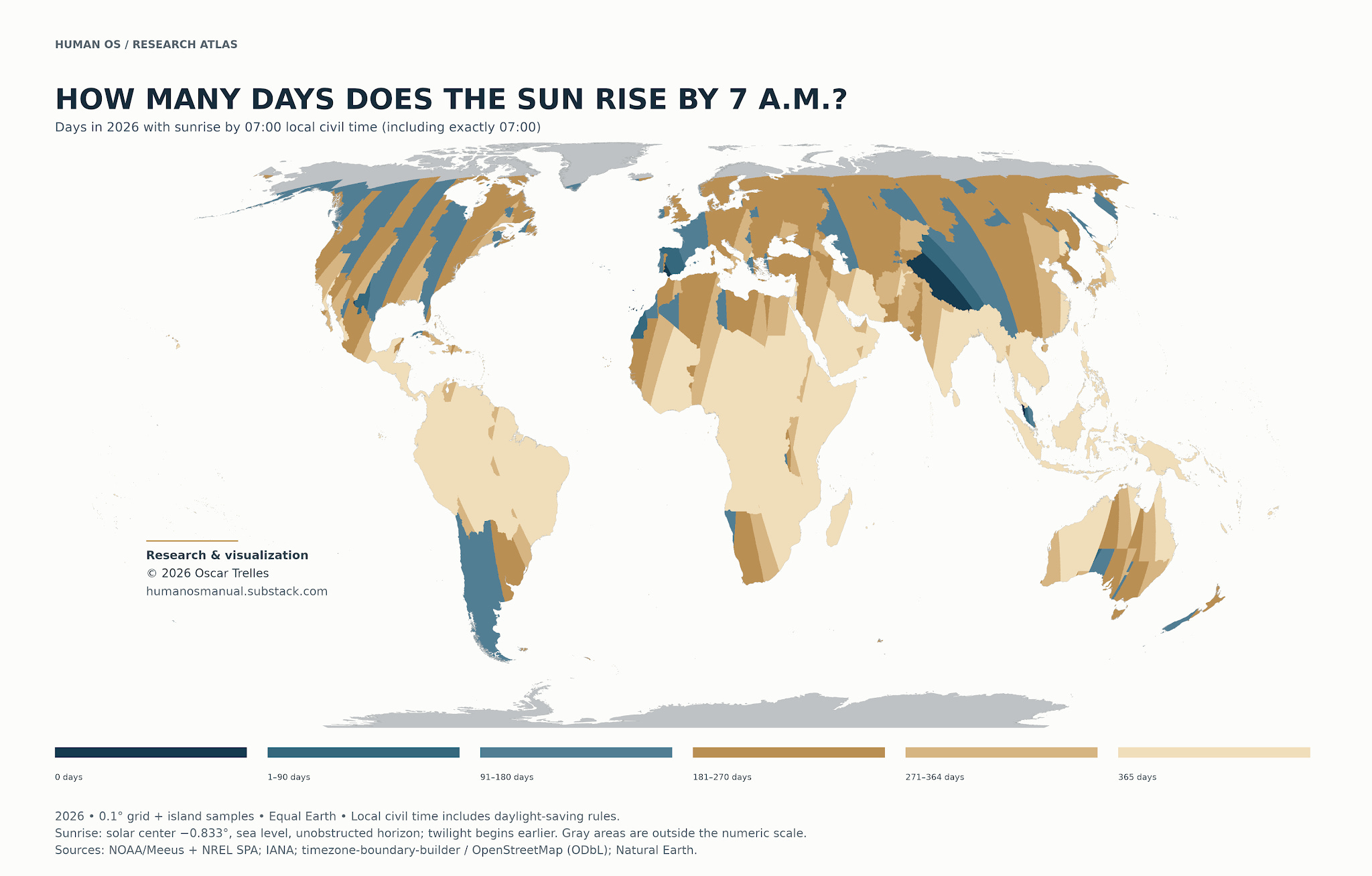
The first map shows how much this one seemingly ordinary condition varies. There are places where sunrise meets that threshold through the year, places where it does so only seasonally, and places where 7 a.m. is consistently too early for sunrise. Geography supplies part of the explanation, but it not all of it.
Latitude changes the length of the day across seasons. Longitude determines where a place sits relative to the Sun within a time zone. Political decisions determine where one time zone ends and another begins, and whether the clock is moved for part of the year. Two locations at similar latitudes can therefore experience very different sunrise times by the clock. Some sharp changes on the map reflect administrative boundaries rather than abrupt changes in the sky.
Spain offers a particularly interesting example. Mainland Spain follows Central European Time, the same as Germany, even though most of the country lies west of the Greenwich meridian. This arrangement dates back to a change in official time in 1940.
The difference is especially pronounced in Galicia, where sunrise occurs relatively late by the clock. You can see that displacement in both maps. The pattern is a consequence of geography interacting with the time zone assigned to it, rather than an unusual movement of the Sun.
Researchers have also examined this relationship along the Spanish-Portuguese border, where populations at similar longitudes live under different official times. A 2022 study found differences in measures of circadian rhythmicity, although the authors acknowledged that cultural and other factors could also contribute.
That does not establish that Spain should change its clocks, or that one country’s schedule is inherently healthier. It illustrates how an administrative decision can become part of the conditions in which people organize their biological lives.
The second map asks a different question: how late does sunrise get at each sampled location during 2026?
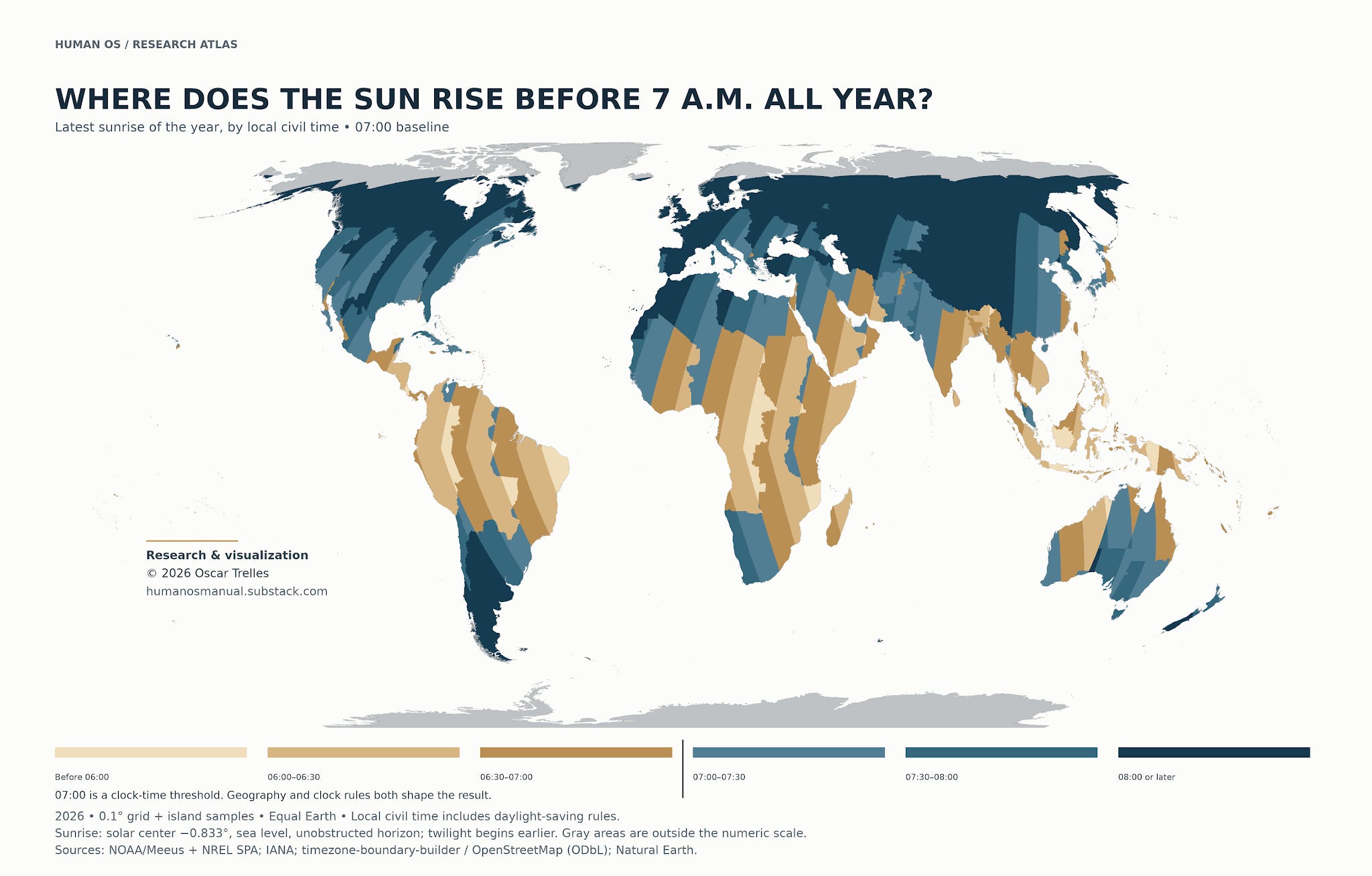
A single annual average would hide the point. Someone may find sunlight readily available at seven for much of the year and still encounter a stretch of mornings when the Sun rises substantially later. A routine described as a fixed clock-time behavior may be practical in one season and unavailable in another, without anything having changed about that person’s motivation or discipline.
These are not maps of healthy and unhealthy places. Nor are they maps of the light that actually reaches people’s eyes. They establish a narrower fact: the environmental event assumed by a fixed-hour recommendation is not equally available across geography or across the calendar.
What The Maps Measure, And What They Do Not
There is an important distinction between sunrise and usable natural light. The sky begins to brighten during twilight before the Sun crosses the horizon. Outdoor exposure may therefore be possible before the sunrise time shown here. The reverse is also true: a sunrise on the clock does not mean a person is outside, unobstructed by buildings, or receiving a particular amount of light.
At high latitudes, the distinction becomes even more important. On some dates the Sun does not cross the horizon at all; depending on the season, it may remain above it or below it. A literal count of sunrise events must not be mistaken for a complete count of mornings with available daylight. The atlas describes a specific astronomical event under stated assumptions, not an individual’s light exposure or circadian response.
That limitation does not weaken the argument. It clarifies exactly what the maps can show and prevents us from claiming more than the research has measured.
The Science Does Not Require a Universal Clock Hour
Light is one of the principal environmental signals that helps synchronize human circadian rhythms with the outside world. Its biological effects depend in part on when exposure occurs relative to a person’s internal circadian timing. Human laboratory research has documented different phase-shifting responses to light across the circadian cycle. Duration, intensity, and the spectral characteristics of light matter as well.
A 2022 international expert consensus in PLOS Biology recommended patterns of brighter light during the day and much lower melanopic light exposure in the evening and night. That is a serious attempt to translate circadian science into measurable environmental conditions. It is also notably more precise than telling everyone to spend ten minutes in morning sunlight before touching a phone.
This is not an argument against morning daylight. It can be useful, but the broader pattern of daily light exposure deserves attention. The point is that a recommendation about light exposure is not the same as a prescription for a particular clock hour, or a moral rule about the order in which someone uses their devices.
The 5 a.m. ideal exposes a related confusion: it tells us when someone woke, but says nothing about when they fell asleep, whether they obtained sufficient sleep, their chronotype, or the obligations that shaped the decision. The American Academy of Sleep Medicine and Sleep Research Society recommend that adults regularly obtain at least seven hours of sleep. Waking at five after adequate sleep and waking at five after going to bed at midnight are not comparable achievements simply because the clock displays the same number.
When a Recommendation Meets a Real Life
Imagine two people reading the same advice. One wakes at six thirty, lives somewhere daylight is available, and can take a short walk before work. The other starts an early shift, leaves home in darkness, and may already be inside a workplace when the Sun rises. Both can understand the biological rationale, but only one can follow the instruction in the form in which it was delivered.
The second person may still be able to seek outdoor light later in the morning or adjust something about their schedule. The realistic options matter. What does not help is to assume that failure to reproduce an idealized morning routine must reflect a failure of discipline.
This is where advice that sounds individually empowering can become strangely indifferent to an individual. A person can influence their behavior, but cannot instantly choose their latitude, move sunrise earlier, or always determine when a shift begins or a child needs care. Work hours, transport, buildings, household responsibilities, and the surrounding environment change the practical cost of following the same recommendation.
None of this eliminates personal responsibility. It gives responsibility a more accurate object. Instead of asking whether someone has complied with an apparently universal instruction, we can ask what the principle is trying to accomplish, which circumstances make it available, and what a workable version would require in that person’s life.
The Same Hour Is Not The Same Morning
I began with a common piece of advice and an ordinary time on the clock. The maps revealed an inconvenient detail: the world does not provide a standardized 7 a.m. Clocks make coordination possible, but they also make different places and different lives look more equivalent than they are.
The larger error is not in recommending daylight, or consistency, or sufficient sleep. It happens when a useful finding is stripped of the conditions that determine whether it can be applied. Once that happens, we begin treating a context problem as a character problem, and a fixed hour as though it were a biological instruction.
The question I would keep from this investigation is not what time everyone should wake up. It is what has to be true about someone’s environment and everyday obligations for a sound recommendation to become a realistic one.
That is a question worth carrying beyond morning sunlight.
It changes how we read any advice that assumes people are operating under the same conditions.
If this way of examining familiar claims against the conditions of real life is useful to you, subscribe. I will be applying the Human OS lens to other developments in health, technology, work, and everyday life.
About This Research
The two maps are original computational estimates produced for the Human OS Research Atlas, using sampled locations around the world, astronomical sunrise calculations, and the local civil-time rules applicable in 2026. The 7 a.m. threshold is illustrative and has no claimed biological significance. Calculations assume sea level and an unobstructed horizon. High-latitude days without a sunrise event require explicit treatment in reading the maps.
This is geographic research about sunrise-event timing, not a measurement of daylight exposure, sleep, circadian phase, adherence, or health outcomes. The interpretation of standardized advice is my synthesis, not an outcome established by the atlas. Computation and visualization were assisted by OpenAI Codex and Python-based tools. This original work has not undergone external peer review.
Research and visualization © 2026 Oscar Trelles. Human OS / Research Atlas. Full reproducibility materials, methodology, validation summary, and underlying research record:https://thehumanosmanual.com/resources/atlas/sunrise-civil-time-2026/
Notes & Sources
Original research
- Oscar Trelles. Human OS / Research Atlas: Sunrise and Civil Time (2026). Original global sunrise calculations and visualizations.
Astronomical methods, time zones, and geographical inputs
- NOAA Global Monitoring Laboratory. Solar Calculation Details.
- National Renewable Energy Laboratory. Solar Position Algorithm reference via pvlib.
- IANA. Time Zone Database.
- Evans Siroky. Timezone Boundary Builder, 2026e. Geographical time-zone boundary data.
- Natural Earth. Geographical land and coastline data.
Clock changes in 2026
- Time and Date. Daylight Saving Time 2026 in Spain (October 25).
- Time and Date. Daylight Saving Time 2026 in the United States (November 1).
- Time and Date. October 2026 daylight saving changes in Australia and New Zealand.
Astronomical methods, time zones, and geographical inputs
- Planesas, Pere. La hora oficial en España, in Cuestiones de Astronomía, Instituto Geográfico Nacional. An authoritative astronomical discussion of Spain's time-zone history and its relation to solar time. IGN publication (PDF).
- Boletín Oficial del Estado. Order of March 7, 1940, published March 8, concerning the advancement of Spain's official time by 60 minutes. Primary historical documentation. BOE, issue 68 (PDF).
- Bonmatí-Carrión, M.-Á., et al. (2022). "Living at the Wrong Time: Effects of Unmatching Official Time in Portugal and Western Spain." Biology, 11(8), 1130. This study compared retired participants in western Spain and Portugal and reported stronger measures of circadian robustness in the Portuguese group, with important limitations concerning confounding and generalizability.
Circadian science and sleep
- Brown, T. M., et al. (2022). "Recommendations for daytime, evening, and nighttime indoor light exposure to best support physiology, sleep, and wakefulness in healthy adults." PLOS Biology. International expert consensus.
- Foster, R. G. (2020). "Sleep, circadian rhythms and health." Interface Focus.
- Khalsa, S. B. S., et al. (2003). "A phase response curve to single bright light pulses in human subjects." The Journal of Physiology. Human laboratory study.
- Watson, N. F., et al. (2015). "Recommended Amount of Sleep for a Healthy Adult: A Joint Consensus Statement of the American Academy of Sleep Medicine and Sleep Research Society." Journal of Clinical Sleep Medicine. Source boundary: the atlas supports claims about calculated sunrise events in local civil time. The external scientific literature supports claims about light, biological timing, and sleep. The argument about how generalized advice encounters work, environment, and individual agency is an interpretation, not a directly tested outcome of this study.